Introduction
In our SA-CCR series, every Adjusted Derivative Contract Amount (ADCA) is the product of four components: Adjusted Notional, Supervisory Delta, Maturity Factor, and Supervisory Factor. The Supervisory Delta article covered how the framework handles direction and optionality. This article covers the Maturity Factor — the component that scales each trade’s contribution to PFE based on how long the exposure remains open and how actively it is margined.
The Maturity Factor answers a specific question: given this trade’s remaining life and its margining arrangement, how much should we scale the notional exposure to reflect the realistic risk horizon? A trade maturing tomorrow carries far less exposure than one maturing in five years. A daily-margined trade is continuously marked to market and collateralised, so its effective exposure window is much shorter than its contractual maturity. The Maturity Factor captures both of these dimensions simultaneously.
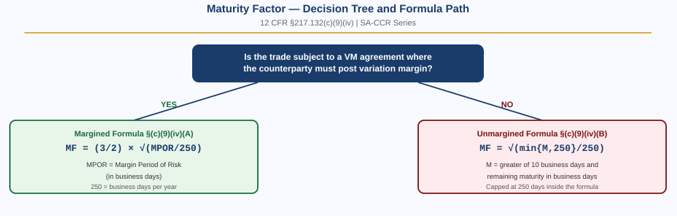
The regulation at §217.132(c)(9)(iv) sets out three distinct paths:
- Path (A): Margined trades — subject to a variation margin agreement under which the counterparty must actually post VM. Uses MPOR as the key input.
- Path (B): Unmargined trades — no VM agreement, or the counterparty is not required to post VM. Uses remaining contract maturity (M) as the key input.
- Path (C): A special election for settled-to-market cleared transactions — treated as margined despite daily cash settlement.
Beyond these three paths, §217.132(c)(9)(v) contains a set of product-specific rules governing how certain complex instruments — binary options, compound options, caps and floors, and linear contracts — must be decomposed before a Maturity Factor is even calculated. These rules are covered in full in the final section of this article.
Where Maturity Factor Sits in the ADCA Formula
Like Supervisory Delta, Maturity Factor is a direct multiplier in the ADCA calculation:
| ADCA = Adjusted Notional × Supervisory Delta × Maturity Factor × Supervisory Factor |
| Maturity Factor is always a positive number between 0 and 1 (for unmargined trades capped at 250 days) or between 0 and a value slightly above 1 (for margined trades with very long MPOR values). It scales the exposure down from full notional to reflect the realistic risk horizon. |
A key point: the Maturity Factor does not change the direction of a position — that is Supervisory Delta’s job. What it does is scale the magnitude of each trade’s contribution to PFE, ensuring that a short-dated trade contributes proportionally less to capital requirements than a long-dated trade with otherwise identical characteristics.
Path (A) — Margined Trades: The MPOR-Based Formula
The regulation at §217.132(c)(9)(iv)(A)(1) prescribes the following formula for derivative contracts subject to a variation margin agreement under which the counterparty is required to post VM:
| MF = (3/2) × √(MPOR / 250) |
| MPOR = Margin Period of Risk in business days | 250 = business days per year | The 3/2 multiplier is a supervisory scaling factor built into the formula |
The formula has three components worth understanding separately before putting them together.
The Square Root of Time
The √(MPOR/250) term converts the MPOR from business days into an annual fraction and then takes the square root. The square root reflects a fundamental principle of quantitative finance: under standard assumptions about how prices move (random walk / Brownian motion), risk scales with the square root of time, not linearly with time. Doubling the MPOR from 10 to 20 days does not double the exposure; it increases it by a factor of √2 ≈ 1.414.
The 3/2 Multiplier
The 3/2 (or 1.5) multiplier is a supervisory conservatism adjustment. Its purpose is to produce a Maturity Factor that is calibrated to be appropriate for a one-tailed 99th percentile confidence interval over the MPOR. Without this scaling factor, the raw square-root formula would understate exposure at the required confidence level. The 3/2 is not derived from first principles in the regulation — it is a regulatory calibration decision, applied uniformly to all margined trades regardless of asset class.
The MPOR Floors
MPOR is not a number a bank can freely choose. §217.132(c)(9)(iv)(A)(2) sets mandatory minimum floors for every type of trade:
| Transaction Type | MPOR Minimum Floor | Regulatory Provision |
| Standard derivative contract (not client-facing) | 10 business days + periodicity of re-margining (in business days) − 1 business day | §(c)(9)(iv)(A)(2)(i) |
| Client-facing derivative transaction | 5 business days + periodicity of re-margining (in business days) − 1 business day | §(c)(9)(iv)(A)(2)(ii) |
| Netting set with >5,000 non-cleared trades, illiquid collateral, or any contract that cannot be easily replaced | 20 business days (regardless of margining frequency) | §(c)(9)(iv)(A)(2)(iii) |
The Re-Margining Periodicity Adjustment
The phrase “periodicity of re-margining expressed in business days minus one business day” is the source of most practical variation in MPOR between different margin agreements. Re-margining periodicity is simply how often collateral is actually exchanged. For daily margining (periodicity = 1 business day):
| MPOR floor = 10 + (1 − 1) = 10 business days |
| For daily-margined standard trades, the periodicity term cancels out completely. |
For weekly margining (periodicity = 5 business days):
| MPOR floor = 10 + (5 − 1) = 14 business days |
| Each additional day between margin calls adds one day to the MPOR floor, reflecting the extra exposure gap between exchanges. |
The Dispute History Override
A fourth provision at §217.132(c)(9)(iv)(A)(3) doubles all the floors above for netting sets with a pattern of margin disputes:
“For a netting set subject to more than two outstanding disputes over margin that lasted longer than the MPOR over the previous two quarters, the applicable floor is twice the amount provided in paragraphs (c)(9)(iv)(A)(1) and (2) of this section.”
This means a daily-margined standard trade where margin disputes have repeatedly dragged on beyond the 10-day floor sees its MPOR floor rise to 20 days — doubling the Maturity Factor from 0.3000 to 0.4243 and increasing capital on every trade in that netting set by 41%.
Path (B) — Unmargined Trades: The Maturity-Based Formula
For derivative contracts that are not subject to a variation margin agreement, or where a VM agreement exists but the counterparty is not required to post variation margin, §217.132(c)(9)(iv)(B) prescribes a different formula:
| MF = √( min{M , 250} / 250 ) |
| M = the greater of 10 business days and the remaining maturity of the contract in business days. The min{M, 250} cap means the formula never exceeds 1.0 regardless of how long the contract runs. |
Two design choices in this formula are worth understanding explicitly.
Why M is Floored at 10 Business Days
Even a trade with only 2 or 3 business days remaining to maturity cannot have M below 10 business days for this formula. This floor reflects a regulatory view that even the most short-dated derivative carries at least two weeks of operational exposure — it takes time to close out a defaulted position, settle cash flows, and re-hedge even the simplest instrument. A trade expiring in 3 days still produces an MF of √(10/250) = 0.2000, not √(3/250) = 0.1095.
Why M is Capped at 250 Days Inside the Formula
The min{M, 250} inside the formula caps the Maturity Factor at √(250/250) = 1.0 for any trade with a remaining maturity at or beyond 250 business days (approximately one year). A 5-year swap and a 20-year bond both produce MF = 1.0 under the unmargined formula. This is not because they carry the same risk; it is because the formula’s purpose is to scale exposures for the ADCA calculation, not to distinguish between very long-dated trades. Very long unmargined trades are treated as if the full regulatory horizon is already captured at a one-year equivalent.
Comparing Margined vs Unmargined at the Same Maturity
| Remaining Maturity | Unmargined MF √(min{M,250}/250) | Margined MF at 10-day MPOR | Margined MF at 20-day MPOR |
| 10 business days (or less) | 0.2000 | 0.3000 | 0.4243 |
| 50 business days | 0.4472 | 0.3000 | 0.4243 |
| 125 business days | 0.7071 | 0.3000 | 0.4243 |
| 250+ business days | 1.0000 | 0.3000 | 0.4243 |
This table reveals something counterintuitive: for short-dated trades (10 to 50 business days remaining maturity), the unmargined MF is actually lower than the margined MF at a 10-day MPOR. A 10-day unmargined trade has MF = 0.2000 versus 0.3000 for a daily-margined trade with the same characteristics. This is because the unmargined formula uses actual remaining maturity as its risk horizon — a trade maturing in 10 days truly only has 10 days of exposure left. The margined formula, by contrast, always anchors to the MPOR (minimum 10 days), not the remaining maturity, because the key risk in a margined portfolio is the gap between collateral exchanges, not the contract’s end date.
Path (C) — The Settled-to-Market (STM) Election
The third path applies to a specific situation: a cleared transaction that daily settles its mark-to-market in cash (the STM mechanism) but is not formally subject to a variation margin agreement in the legal sense. Without intervention, this trade would fall under Path (B) — the unmargined formula — potentially producing a much higher Maturity Factor for longer-dated instruments.
§217.132(c)(5)(v) allows a bank to elect to treat such a cleared, daily-settled transaction as if it were subject to a variation margin agreement for the purposes of the SA-CCR calculation. Where that election is made, §217.132(c)(9)(iv)(C) specifies how the Maturity Factor is determined:
“If a Board-regulated institution has elected pursuant to paragraph (c)(5)(v) of this section to treat a derivative contract that is a cleared transaction that is not subject to a variation margin agreement as one that is subject to a variation margin agreement, the Board-regulated institution must treat the derivative contract as subject to a variation margin agreement with maturity factor as determined according to (c)(9)(iv)(A) of this section, and daily settlement does not change the end date of the period referenced by the derivative contract.”
Three things follow directly from this provision:
- The margined Maturity Factor formula — MF = (3/2) × √(MPOR/250) — applies, not the unmargined formula.
- All MPOR floors from paragraph (c)(9)(iv)(A)(2) apply in full: 10-day standard minimum, 5-day client-facing minimum, 20-day large/illiquid minimum. Daily cash settlement does not reduce these floors to 1 day or any other shorter period.
- The daily cash settlement does not change the end date of the derivative contract. The contract’s maturity — used for time-bucket assignment in the hedging set calculation — remains anchored to the actual contractual expiry, not reset to tomorrow each day.
Product-Specific Rules — Derivative Contracts as Multiple Effective Contracts
Before applying any Maturity Factor, §217.132(c)(9)(v) requires banks to first check whether a derivative contract must be decomposed into multiple separate contracts. This section contains four specific rules covering binary options, compound option structures, multi-payment options such as caps and floors, and a prohibition on decomposing linear instruments. These rules directly affect how many ADCAs a single trade generates, and therefore how many Maturity Factors must be calculated.
Rule (A) — Binary Options
A binary option pays a fixed predetermined amount if the underlying is above (for a call) or below (for a put) the strike at expiry, and nothing otherwise. The regulation at §217.132(c)(9)(v)(A) requires this to be decomposed into two separate European options:
“For an option where the counterparty pays a predetermined amount if the value of the underlying asset is above or below the strike price and nothing otherwise (binary option), the option must be treated as two separate options.”
Specifically, the binary option with original strike K is represented as the combination of one bought European option and one sold European option of the same type (put or call) with strikes set at 0.95 × K and 1.05 × K respectively. This bracket around the original strike reproduces the binary payoff profile outside the region between the two strikes.
One important constraint: the absolute value of the sum of the two resulting ADCAs (one from the bought option, one from the sold option) is capped at the payoff amount of the original binary option. This prevents the decomposition from overstating the exposure.
Rule (B) — Compound Option Structures
For a derivative contract that can be represented as a combination of standard option payoffs — examples given in the regulation include collars, butterfly spreads, calendar spreads, straddles, and strangles — the bank must treat each standard option component as a separate derivative contract. Each component gets its own ADCA, with its own Supervisory Delta, Adjusted Notional, Maturity Factor, and Supervisory Factor.
This rule prevents banks from netting the exposures of the individual option legs within a structured product before applying the SA-CCR calculation. A straddle, for example, contains a bought call and a bought put. The regulation requires these to be calculated separately and their ADCAs summed, rather than calculated as a single combined position.
Rule (C) — Multi-Payment Options: Caps and Floors
Interest rate caps and floors are multi-payment option structures — a cap is a series of individual caplets, each of which is a call option on a specific period’s interest rate, and a floor is a series of floorlets. Rule (C) at §217.132(c)(9)(v)(C) gives banks an explicit permission (not a requirement) to decompose these:
“For a derivative contract that includes multiple-payment options, (such as interest rate caps and floors), a Board-regulated institution may represent each payment option as a combination of effective single-payment options (such as interest rate caplets and floorlets).”
The word “may” is deliberate: decomposing a cap into individual caplets is optional. A bank that does not decompose treats the entire cap as one derivative contract, with one Maturity Factor calculated using the cap’s overall remaining maturity. A bank that does decompose calculates a separate ADCA for each caplet, each with its own time to expiry T — and therefore a different Supervisory Delta and potentially a different time-bucket assignment for the hedging set aggregation.
Rule (D) — The Prohibition on Decomposing Linear Contracts
The final rule closes a potential loophole: banks cannot decompose linear derivative contracts (such as swaps) into components to manipulate their SA-CCR calculation. The regulation at §217.132(c)(9)(v)(D) is explicit:
“A Board-regulated institution may not decompose linear derivative contracts (such as swaps) into components.”
This rule prevents, for example, a bank from treating a 5-year interest rate swap as two separate 2.5-year instruments, or splitting a cross-currency swap into its interest rate and FX components for the purpose of assigning lower Maturity Factors to each piece separately. A cross-currency swap’s interest rate exposure and FX exposure are indeed calculated separately for hedging set assignment (IR vs. FX), but that split is required by the hedging set structure — not by this provision, and the decomposition cannot be used to manipulate either the Maturity Factor or the Supervisory Delta calculation.
Comparing Margined and Unmargined at Key MPOR / Maturity Points
| Scenario | MPOR / M (days) | Maturity Factor | Notes |
| Margined, daily, standard | 10 | 0.3000 | Baseline margined trade |
| Margined, daily, client-facing | 5 | 0.2121 | Client-facing 5-day floor |
| Margined, weekly, standard | 14 | 0.3550 | Periodicity adds 4 days |
| Margined, 20-day floor (large set / dispute) | 20 | 0.4243 | Large netting set or dispute history |
| Unmargined, 1-week to expiry (<10 days) | 10 (floored) | 0.2000 | Floor applies even for near-expiry trades |
| Unmargined, 3-month maturity | 63 | 0.5021 | sqrt(63/250) |
| Unmargined, 6-month maturity | 126 | 0.7099 | sqrt(126/250) |
| Unmargined, 1-year+ maturity | 250 (capped) | 1.0000 | Capped at 1.0 regardless of longer maturity |
| STM election, 5-year cleared swap | 10 (margined MPOR) | 0.3000 | 70% lower than unmargined equivalent at 1.0 |