Introduction
Every article in this SA-CCR series has used the Maturity Factor to scale each trade’s Adjusted Derivative Contract Amount — and at the heart of that Maturity Factor sits a number called MPOR: the Margin Period of Risk.
MPOR is the regulatory answer to a practical question: if a counterparty defaults today and stops posting collateral, how many days will pass before the bank has fully replaced those contracts and re-hedged all of its resulting market risk? That window — however many business days long it turns out to be — is precisely what needs to be captured in the exposure calculation. The longer the window, the more the exposure could grow before the bank is made whole, and therefore the higher the capital charge must be.
The regulation covers MPOR in two distinct places in §217.132, serving two different calculation frameworks:
- Context 1: §217.132(c)(9)(iv) — the SA-CCR Standardized Approach, where MPOR is an input to the Maturity Factor formula used to calculate every ADCA
- Context 2: §217.132(d)(5) — the Internal Models Methodology (IMM), where MPOR has a fuller, more precise definition and governs how collateral agreements are captured inside a bank’s own EAD model
This article covers both contexts in full — their definitions, their regulatory floors, their worked examples — with a clear separation between the two so you can see exactly how MPOR functions in each regime.
What is the Margin Period of Risk?
The regulation defines MPOR directly in the context of the Maturity Factor formula at §217.132(c)(9)(iv)(A)(1):
“MPOR refers to the period from the most recent exchange of collateral covering a netting set of derivative contracts with a defaulting counterparty until the derivative contracts are closed out and the resulting market risk is re-hedged.”
https://www.ecfr.gov/current/title-12/chapter-II/subchapter-A/part-217
Break this down into three sequential phases, each of which contributes time to the total MPOR:
| Phase | What Happens | Who Bears the Risk |
| Phase 1 | From the last collateral exchange to the point the bank can act on the default — the gap during which the counterparty has stopped posting margin but the bank cannot yet close out positions | Bank is fully exposed — no fresh collateral, contracts still open |
| Phase 2 | The time required to sell and realize the proceeds of the least liquid collateral the counterparty delivered under the terms of the agreement | Bank may hold collateral but cannot yet convert it to cash |
| Phase 3 | Where applicable, the time required to re-hedge the market risk resulting from the closed-out positions | Bank has cash from collateral but carries open market risk until new hedges are in place |
The sum of all three phases — measured in business days — is the MPOR. The key insight is that MPOR is not just the time to close out a trade. It also captures how long it takes to realize collateral proceeds and replace the market risk. A trade referencing an illiquid underlying, or collateralised by hard-to-sell securities, will naturally produce a longer MPOR than one that is liquid on both sides.
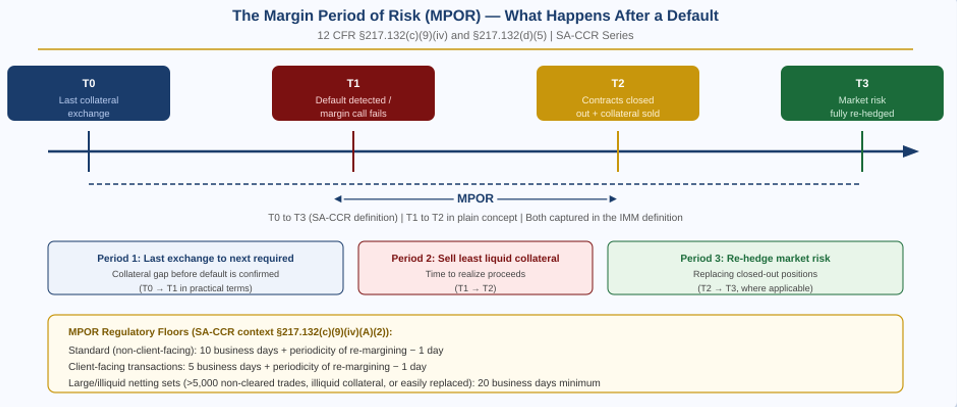
Figure 1: The three phases of MPOR — from last collateral exchange to fully re-hedged position | Source: 12 CFR §217.132(c)(9)(iv) and (d)(5)
Context 1 — MPOR in SA-CCR: The Maturity Factor Formula
In the Standardized Approach (SA-CCR), MPOR feeds directly into the Maturity Factor (MF) — one of the four components used to calculate every Adjusted Derivative Contract Amount (ADCA), as covered across Parts 3 through 7 of our SA-CCR series.
The Maturity Factor formula under §217.132(c)(9)(iv)(A)(1) for trades subject to a variation margin agreement is:
| MF = (3/2) × √(MPOR / 250) |
| MPOR is in business days. The 250 denominator converts to an annual scale (250 business days per year). The 3/2 multiplier is a conservative regulatory scaling factor built into the formula. |
This formula applies specifically to derivative contracts subject to a variation margin (VM) agreement under which the counterparty is actually required to post VM. Where no VM agreement exists — or where the counterparty is not required to post VM under the agreement — a different formula applies (the unmargined formula covered in Context 1B below).
The Regulatory MPOR Floors Under SA-CCR
The regulation does not leave MPOR to a bank’s discretion. §217.132(c)(9)(iv)(A)(2) sets three specific minimum floors that override any lower value a bank might calculate or assume:
| Transaction Type | MPOR Floor | Regulatory Source |
| Standard derivative contract (not client-facing) | 10 business days + periodicity of re-margining − 1 business day | §217.132(c)(9)(iv)(A)(2)(i) |
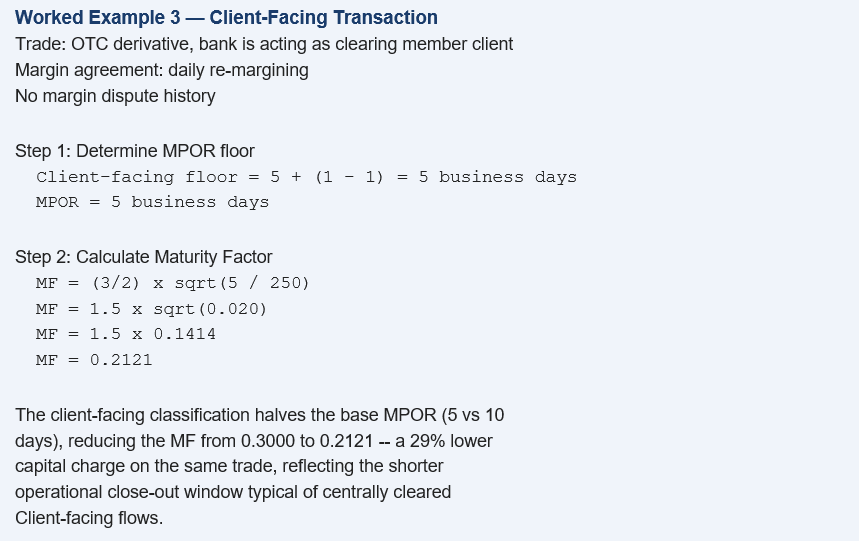
| Client-facing derivative transaction | 5 business days + periodicity of re-margining − 1 business day | §217.132(c)(9)(iv)(A)(2)(ii) |
| Netting set with >5,000 non-cleared derivative contracts, illiquid collateral, or any derivative contract that cannot be easily replaced | 20 business days minimum | §217.132(c)(9)(iv)(A)(2)(iii) |
The phrase “periodicity of re-margining expressed in business days minus one business day” is worth unpacking carefully, because it is the source of most practical variation in MPOR across different margin agreements.
What Does Re-Margining Periodicity Mean?
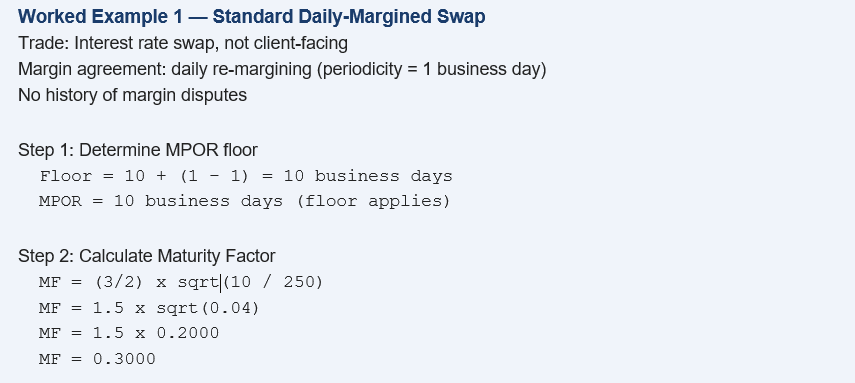
Re-margining periodicity is simply how often collateral is exchanged under the margin agreement. For a standard daily-margined agreement, the periodicity is 1 business day. Substituting into the floor formula for a standard (non-client-facing) trade:
| MPOR floor = 10 + (1 − 1) = 10 business days |
| For a daily-margined standard trade, the periodicity term cancels out and the floor collapses to the base 10 days. |
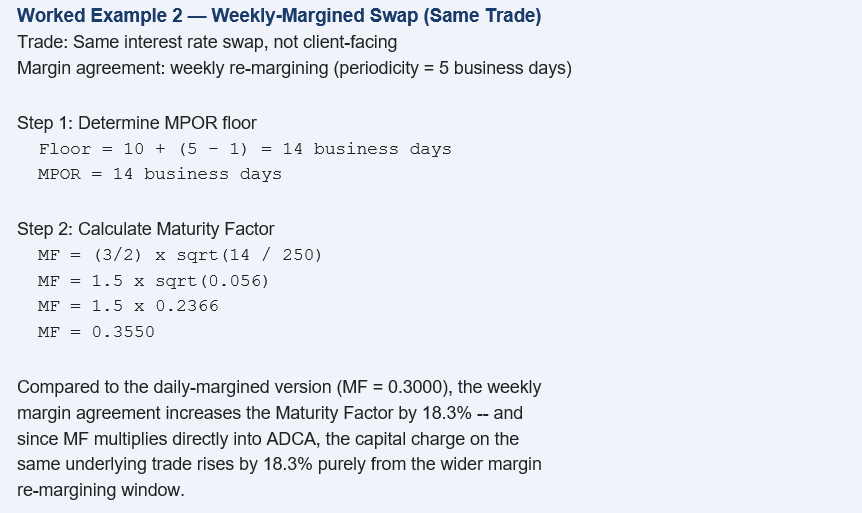
Now consider a weekly-margined agreement, where collateral is exchanged every 5 business days:
| MPOR floor = 10 + (5 − 1) = 14 business days |
| The less frequently collateral moves, the longer the effective MPOR floor — exactly as you would expect, since a 4-day gap between margin calls means up to 4 extra days of uncovered exposure during which a default could occur without triggering a fresh call. |
The Dispute Override — Doubling the Floor
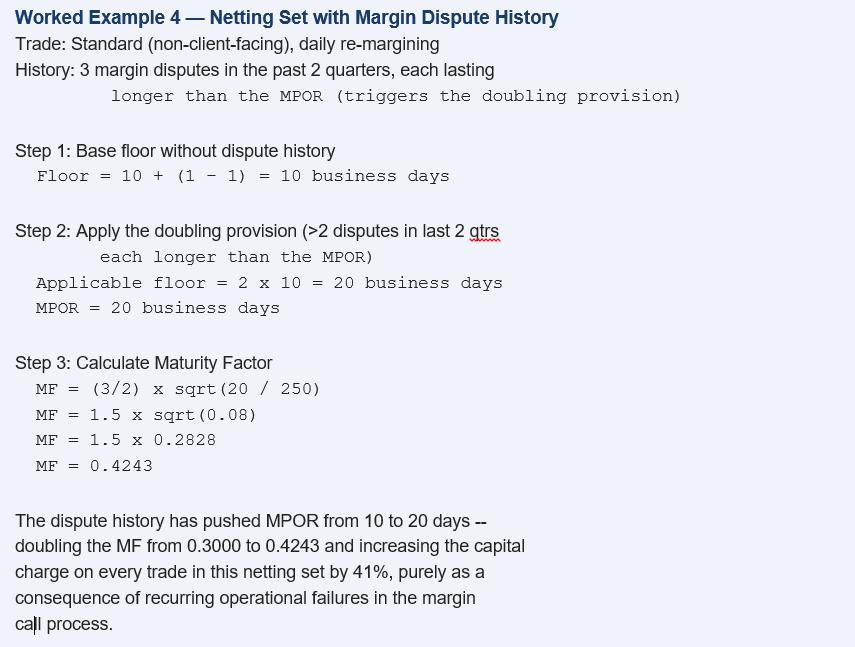
A fourth provision at §217.132(c)(9)(iv)(A)(3) overrides all three floors above for netting sets with a history of margin disputes:
“For a netting set subject to more than two outstanding disputes over margin that lasted longer than the MPOR over the previous two quarters, the applicable floor is twice the amount provided in paragraphs (c)(9)(iv)(A)(1) and (2) of this section.”
In plain terms: if a bank and its counterparty have argued about margin calls more than twice in the last six months — and those disputes dragged on longer than the MPOR itself — the regulatory floor for that netting set doubles. A standard 10-day MPOR becomes a 20-day floor; a client-facing 5-day MPOR becomes 10 days.
This provision exists because repeated margin disputes are a direct signal of operational fragility in the margin process itself. If the two parties cannot resolve a margin call within the expected MPOR, the regulatory response is to assume that future disputes will also take longer than expected — and to build that extended exposure window into the capital calculation accordingly.
Context 1B — The Unmargined Maturity Factor
For completeness, §217.132(c)(9)(iv)(B) sets out the Maturity Factor for trades that are not subject to a variation margin agreement, or where the counterparty is not required to post VM. This formula does not use MPOR — instead it uses M, the remaining maturity of the contract:
| MF = √( min{M , 250} / 250 ) |
| M = the greater of 10 business days and the remaining maturity of the contract, as measured in business days. Capped at 250 days in the formula. |
MPOR is irrelevant here because without a margin agreement, there is no periodic collateral exchange to anchor the risk window to — the exposure is simply measured over the remaining life of the contract.
Context 1C — The Settled-to-Market Election
One more provision within §217.132(c)(9)(iv)(C) governs a specific cleared-transaction election relevant to the daily-settlement/STM question raised earlier in this series. Where a bank has elected under §217.132(c)(5)(v) to treat a cleared transaction that is not subject to a VM agreement as though it were subject to one, the regulation is explicit:
“The Board-regulated institution must treat the derivative contract as subject to a variation margin agreement with maturity factor as determined according to (c)(9)(iv)(A) of this section, and daily settlement does not change the end date of the period referenced by the derivative contract.”
This confirms directly from the source what we discussed in our earlier exchange on STM: the trade uses the margined MF formula (and hence an MPOR), but daily cash settlement does not reset or shorten the contract’s actual end date for any other purpose. The end date stays anchored to when the contract contractually matures.
Worked Examples — SA-CCR MPOR and Maturity Factor
Will continue on the next article on MPOR in IMM. Read it here:
https://decode-finance.com/category/market-risk-credit-risk-and-operational-risks