Introduction
In our SA-CCR series, every Adjusted Derivative Contract Amount (ADCA) is built from four components multiplied together: Adjusted Notional, Supervisory Delta, Maturity Factor, and Supervisory Factor. We covered the Adjusted Notional in depth for each asset class, the Maturity Factor in our dedicated MPOR article, and the Supervisory Factor in Table 3. This article closes the final remaining piece: Supervisory Delta.
Supervisory Delta is the component that tells the SA-CCR framework two things simultaneously: the direction of the position (is the bank long or short the risk factor?) and, for options and CDO tranches, the sensitivity of the contract’s fair value to a small movement in the underlying risk factor. It is how SA-CCR converts every derivative contract — regardless of its payoff structure — into a signed, scaled exposure measure that correctly reflects both the magnitude and direction of the bank’s risk.
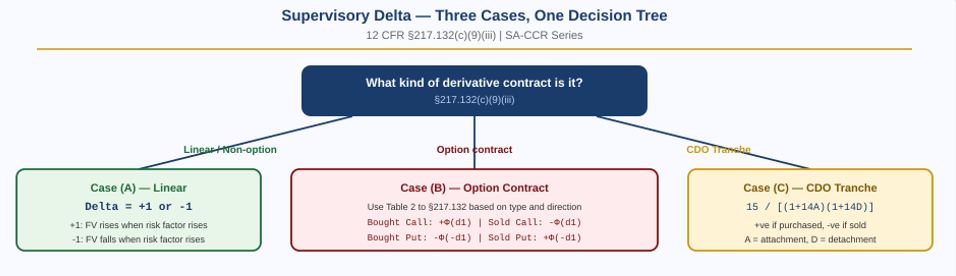
The regulation sets out three distinct cases at §217.132(c)(9)(iii), each corresponding to a different type of derivative contract:
- Case (A): All derivative contracts that are not option contracts or CDO tranches — this is the simple +1 / −1 rule covering swaps, forwards, futures, and most standard derivatives
- Case (B): Option contracts — where Supervisory Delta is calculated using Black-Scholes-style formulas from Table 2 to §217.132, incorporating current price, strike, time to expiry, and a supervisory option volatility
- Case (C): Collateralised debt obligation (CDO) tranches — where a specialised formula based on attachment and detachment points captures the tranche’s position within the capital structure
This article covers all three cases in full, including every variable definition, every special provision, and worked examples across multiple asset classes.
Where Supervisory Delta Sits in the ADCA Formula
Before going into each case, it is worth being precise about what Supervisory Delta actually does in the full ADCA calculation:
| ADCA = Adjusted Notional × Supervisory Delta × Maturity Factor × Supervisory Factor |
| Supervisory Delta is the only signed component in this formula. Adjusted Notional, Maturity Factor, and Supervisory Factor are always positive. Delta alone determines whether a trade adds to or offsets the hedging set exposure. |
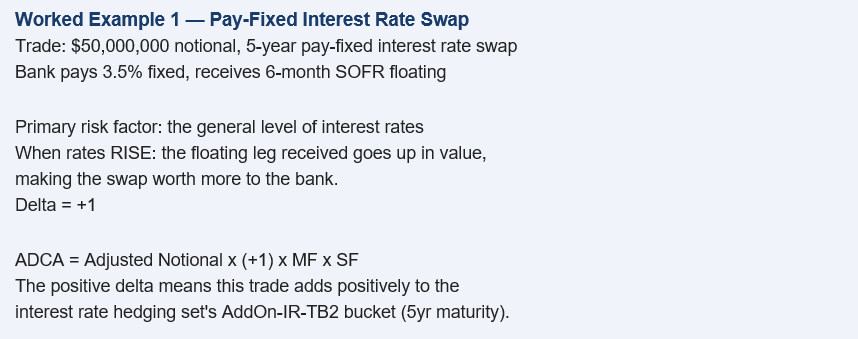
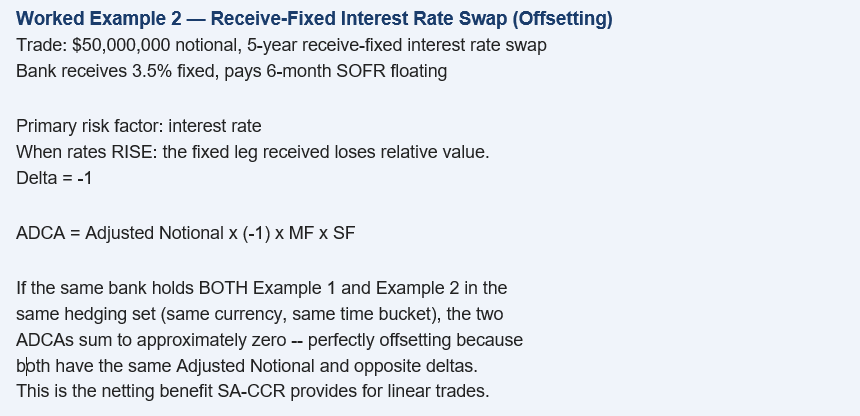
Because Delta is the only signed term, it is also the only mechanism through which offsetting positions within a hedging set can reduce the total exposure. A bank with a long EUR/USD forward (Delta +1) and a short EUR/USD forward (Delta −1) of equal Adjusted Notional will see those two ADCAs add to +1 and −1, which net to zero within the hedging set sum before the Hedging Set Amount formula is applied. This is the primary risk-reduction mechanism within SA-CCR for linear trades.
For options and CDO tranches, the fractional Delta values between −1 and +1 reflect the fact that these instruments only partially respond to movements in the underlying risk factor — an out-of-the-money option, for instance, moves much less dollar-for-dollar than the underlying, and the delta formula captures this partial sensitivity precisely.
Case (A) — Linear Instruments: The +1 / −1 Rule
The regulation at §217.132(c)(9)(iii)(A) is direct:
“For a derivative contract that is not an option contract or collateralized debt obligation tranche, the supervisory delta adjustment is 1 if the fair value of the derivative contract increases when the value of the primary risk factor increases and −1 if the fair value of the derivative contract decreases when the value of the primary risk factor increases.”
https://www.ecfr.gov/current/title-12/chapter-II/subchapter-A/part-217
In plain terms: the bank looks at the primary risk factor of the contract — the interest rate, exchange rate, equity price, credit spread, or commodity price that drives the contract’s value — and asks one question: does the contract gain value when that risk factor goes up, or does it lose value? The answer is the entire Supervisory Delta for that contract.
What Counts as a Linear Instrument?
Every derivative contract that is not structured as an option or a CDO tranche falls under Case (A). In practice, this covers:
| Instrument | Primary Risk Factor | Delta Direction |
| Pay-fixed interest rate swap | Interest rate (the fixed rate level) | The bank PAYS fixed and receives floating. When rates rise, the swap gains value for the bank. Delta = +1 |
| Receive-fixed interest rate swap | Interest rate | The bank RECEIVES fixed and pays floating. When rates rise, the swap loses value. Delta = −1 |
| Long FX forward (long EUR/USD) | Exchange rate (EUR/USD spot) | Value rises when EUR strengthens. Delta = +1 |
| Short FX forward (short EUR/USD) | Exchange rate | Value rises when EUR weakens. Delta = −1 |
| Long equity total return swap | Equity price (the reference stock or index) | Value rises when the stock price rises. Delta = +1 |
| Short equity total return swap | Equity price | Value falls when the stock rises. Delta = −1 |
| Sold CDS (protection seller) | Credit spread of reference entity | Value falls when the reference entity’s credit spread widens (credit deteriorates). Delta = −1 |
| Bought CDS (protection buyer) | Credit spread | Value rises when the credit spread widens. Delta = +1 |
| Long commodity forward | Commodity price | Value rises when the commodity price rises. Delta = +1 |
| Short commodity forward | Commodity price | Value falls when the commodity price rises. Delta = −1 |
Notice the CDS direction: a protection seller (who collects the premium and must pay out on default) has a negative delta under this convention. The seller loses value when the reference entity’s credit spread widens — which is the same direction as a long bond position, and both receive Delta −1 in the SA-CCR framework.
Worked Examples — Linear Instruments
Case (B) — Option Contracts: Table 2 to §217.132
Option contracts require a different approach because their sensitivity to the underlying risk factor is not constant — it changes with the level of the underlying relative to the strike price, with the time remaining to expiry, and with volatility. A deep-in-the-money option behaves almost like a linear position (delta close to ±1), while a far-out-of-the-money option has a delta close to zero.
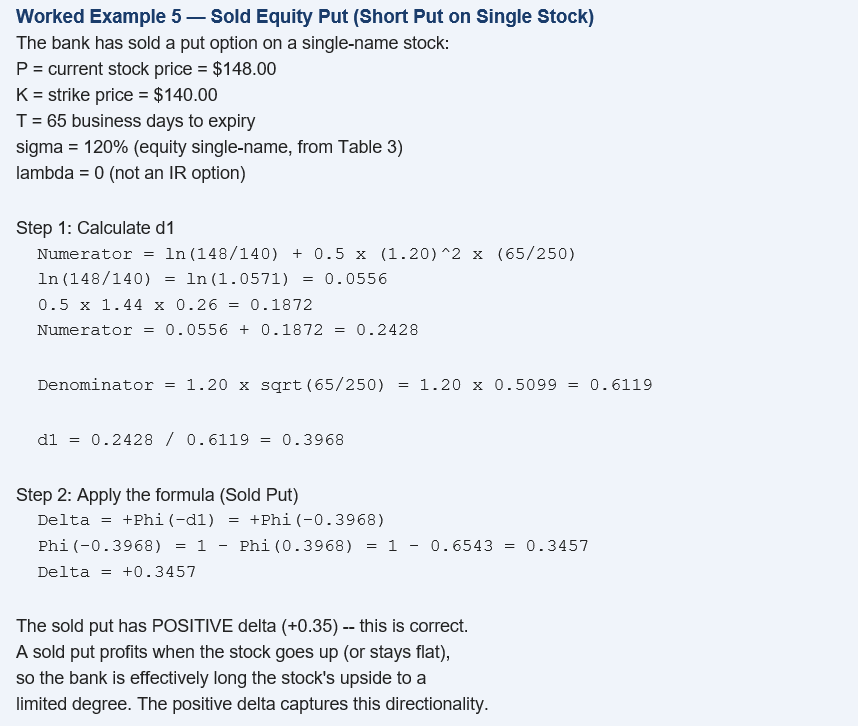
The regulation at §217.132(c)(9)(iii)(B)(1) provides four formulas from Table 2 — one for each combination of option type (call or put) and position direction (bought or sold). All four formulas share the same analytical core, differing only in their sign and which tail of the normal distribution they reference.
The core argument of all four formulas — what is commonly called d1 in Black-Scholes — is:
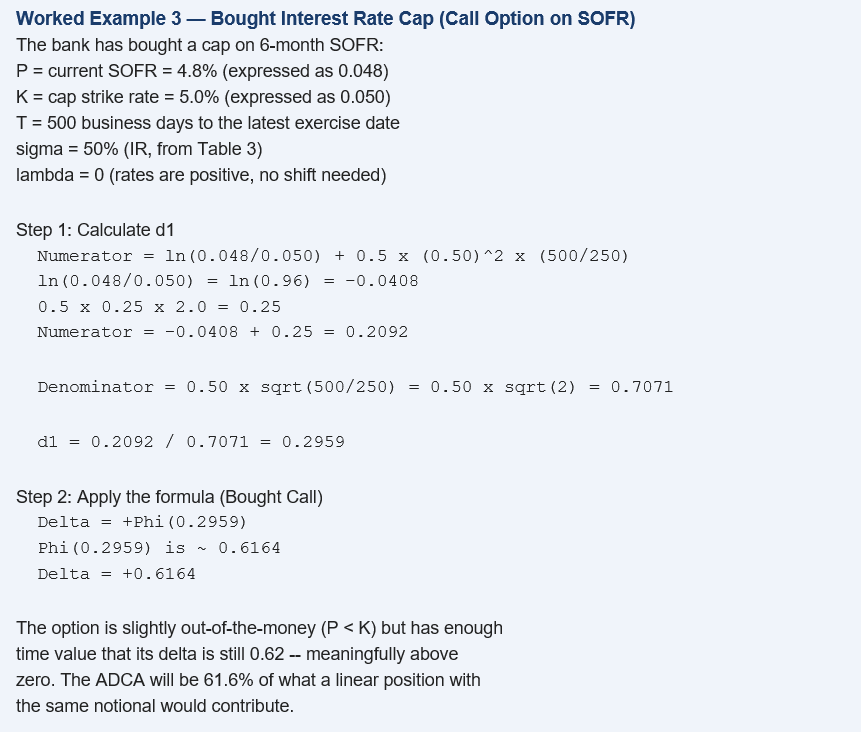
| d1 = [ ln((P+λ)/(K+λ)) + 0.5 × σ² × T/250 ] / [ σ × √(T/250) ] |
| This is the same d1 used in the Black-Scholes model, modified with the lambda shift for negative interest rates. T is divided by 250 to convert business days to annual units. |
The Four Option Delta Formulas from Table 2
| Option Type | Position | Supervisory Delta Formula |
| Call option | Bought (long) | +Φ(d1) |
| Call option | Sold (short) | −Φ(d1) |
| Put option | Bought (long) | −Φ(−d1) |
| Put option | Sold (short) | +Φ(−d1) |
Note the sign convention: for a bought call, delta is positive (Φ(d1) is always between 0 and 1). For a sold call, delta is the negative of that — the bank’s exposure runs in the opposite direction. For puts, the argument inside Φ is negated (−d1), reflecting that put values move inversely to the underlying. A bought put has negative delta (the option gains value when the underlying falls); a sold put has positive delta.
All Six Variables Defined
| Variable | Definition | Regulatory Source |
| Φ | Standard normal cumulative distribution function — the probability that a standard normal variable is less than or equal to the argument | §217.132(c)(9)(iii)(B)(2)(i) |
| P | The current fair value of the instrument or risk factor, as applicable, underlying the option | §217.132(c)(9)(iii)(B)(2)(ii) |
| K | The strike price of the option | §217.132(c)(9)(iii)(B)(2)(iii) |
| T | The number of business days until the latest contractual exercise date of the option | §217.132(c)(9)(iii)(B)(2)(iv) |
| λ | Zero for all derivative contracts, except interest rate options for currencies where interest rates have negative values. For those currencies: λ = max{−L + 0.1%, 0} where L is the lowest value of P or K across all IR options in that currency with all counterparties | §217.132(c)(9)(iii)(B)(2)(v) |
| σ | The supervisory option volatility, as provided in Table 3 to §217.132. Varies by asset class and sub-category. | §217.132(c)(9)(iii)(B)(2)(vi) |
Supervisory Option Volatility (σ) from Table 3
The σ value used inside the delta formula is not a market-implied or bank-estimated volatility. It is a fixed supervisory figure prescribed in Table 3 to §217.132:
| Asset Class | Category / Sub-category | Supervisory Option Volatility (σ) |
| Interest Rate | All | 50% |
| Exchange Rate | All | 15% |
| Credit, single name | Investment Grade | 100% |
| Credit, single name | Speculative Grade | 100% |
| Credit, single name | Sub-speculative Grade | 100% |
| Credit, index | Investment Grade | 80% |
| Credit, index | Speculative Grade | 80% |
| Equity, single name | All | 120% |
| Equity, index | All | 75% |
| Commodity | Energy — Electricity | 150% |
| Commodity | Energy — Other | 70% |
| Commodity | Metals | 70% |
| Commodity | Agricultural | 70% |
| Commodity | Other | 70% |
The variation across asset classes is deliberate and wide. An interest rate option uses 50% volatility; an electricity option uses 150% — three times higher. These figures reflect the regulation’s supervisory view of each asset class’s typical option-implied volatility under stressed conditions, calibrated to be conservative rather than to match current market levels exactly. A bank cannot substitute its own volatility estimate or a market-observed implied vol for these supervisory figures.
The Lambda (λ) Adjustment for Negative Interest Rates
The lambda provision in paragraph (c)(9)(iii)(B)(2)(v) addresses a specific mathematical problem: the Black-Scholes formula requires the logarithm of P/K, and a logarithm is undefined when P or K is zero or negative. In interest rate markets, rates can become and have become negative (negative EURIBOR, negative CHF LIBOR historically), making this a real operational issue, not a theoretical one.
The regulation’s solution is to shift both P and K upward by a common amount λ before taking the logarithm, preserving the relative relationship between P and K while ensuring both arguments remain positive:
| λ = max { −L + 0.1%, 0 } |
| L is the lowest value of P or K across ALL interest rate options in that specific currency that the bank has with ALL counterparties. If the lowest rate in the book is L = −0.5%, then λ = max{0.5% + 0.1%, 0} = 0.6%. |
Three key features of the lambda rule stand out. First, it is currency-specific: the lambda for EUR options is calculated separately from the lambda for JPY options or GBP options, since different currencies have different rate environments. Second, it must be applied consistently: the same value of λ must be used for all interest rate options denominated in the same currency, regardless of the individual trade’s own P and K values. Third, it is floored at zero: if the lowest rate in the book is already positive, λ = 0 and the formula reduces to the standard Black-Scholes form with no shift applied.
Worked Examples — Option Contracts
Case (C) — Collateralised Debt Obligation Tranches
The third and most specialised case covers derivative contracts that are CDO tranches. A CDO tranche is not an option on a reference entity’s credit spread; it is a structured product that gives the bank exposure to a specific slice of credit losses on a pool of underlying assets. The standard linear (+1/−1) and option delta formulas are not appropriate here because the risk profile of a CDO tranche is fundamentally non-linear and determined by the tranche’s position in the capital structure.
The regulation at §217.132(c)(9)(iii)(C)(1) provides a bespoke formula for the supervisory delta adjustment of a CDO tranche:
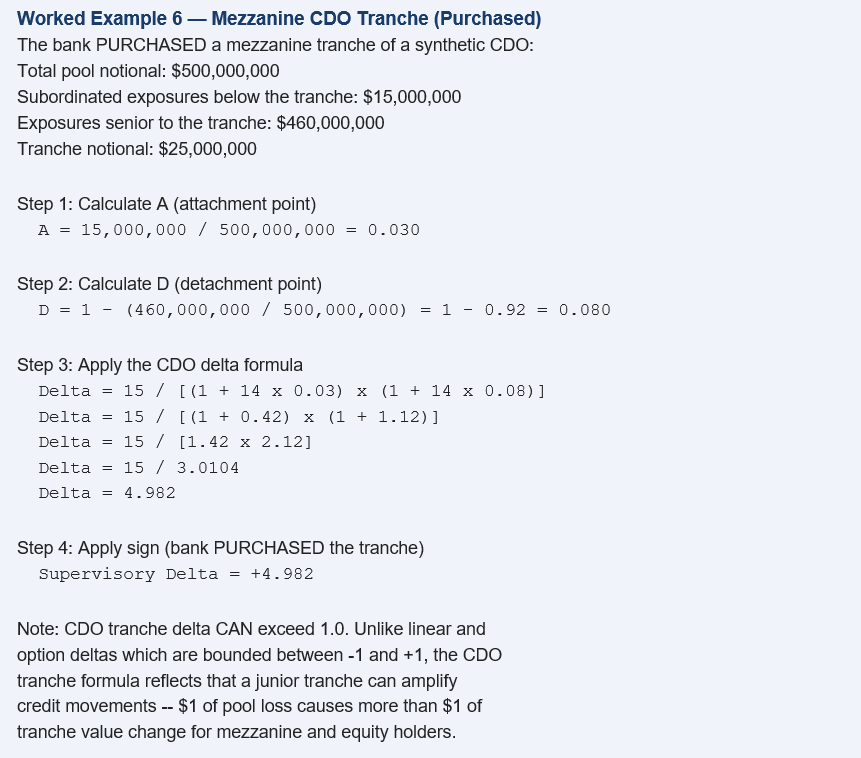
| Supervisory Delta = 15 / [ (1 + 14×A) × (1 + 14×D) ] |
| A = attachment point (decimal, 0 to 1) | D = detachment point (decimal, 0 to 1). Result is positive if the bank purchased the tranche, negative if sold. |
Understanding Attachment and Detachment Points
These two parameters define exactly where the tranche sits within the CDO’s capital structure:
| Variable | Definition | Example |
| A (Attachment point) | The ratio of notional amounts of all underlying exposures SUBORDINATED to the bank’s exposure, to the total notional of all underlying exposures. Expressed as a decimal from 0 to 1. | A=0.03 means losses on the pool must exceed 3% before this tranche starts absorbing losses |
| D (Detachment point) | One minus the ratio of notional amounts of all underlying exposures SENIOR to the bank’s exposure, to the total notional of all underlying exposures. Expressed as a decimal from 0 to 1. | D=0.07 means the tranche absorbs losses up to 7% of the pool; above 7%, more senior tranches bear the loss |
The tranche the bank holds covers losses from A to D. For A=0.03 and D=0.07, the tranche is a 4% wide slice covering the third through seventh percent of pool losses. An equity/first-loss tranche typically has A=0 (it starts absorbing losses immediately). A senior tranche typically has a high A value (it is well-protected by subordination before any losses reach it).
Special Note on First-to-Default and Subsequent-to-Default Derivatives
The regulation provides a footnote [30] that directly addresses first-to-default and nth-to-default credit derivatives, which have a similar tranche-like structure. For a first-to-default credit derivative, there are no underlying exposures subordinated to the bank’s exposure, so A = 0. For a second-or-subsequent-to-default derivative, the smallest (n−1) notional amounts of the underlying exposures are treated as subordinated to the bank’s exposure, and A is calculated accordingly.
How the CDO Tranche Formula Behaves
The formula 15/[(1+14A)(1+14D)] produces values that intuitively match a tranche’s risk profile:
- Equity tranche (A=0, D small): both terms in the denominator are relatively small, so delta is larger — the first-loss tranche has high sensitivity to credit movements.
- Mezzanine tranche (A=0.03, D=0.07): delta is moderate — the tranche is affected by credit movements but is partially protected by subordination.
- Senior tranche (A=0.10, D=0.20 or higher): both denominator terms are large, so delta is small — the senior tranche is well-insulated and has low sensitivity to credit movements in the underlying pool.
Sign Convention for CDO Tranches
Unlike the linear and option cases where the sign emerges naturally from the payoff direction, the CDO tranche formula always produces a positive number. The regulation at §217.132(c)(9)(iii)(C)(2)(iii) makes the sign explicit:
“The resulting amount is designated with a positive sign if the collateralized debt obligation tranche was purchased by the Board-regulated institution and is designated with a negative sign if the collateralized debt obligation tranche was sold by the Board-regulated institution.”
So a bank that bought a CDO tranche (is long the credit risk of that slice) applies a positive delta; a bank that sold a CDO tranche (is short that slice of credit risk, as in a synthetic CDO protection seller) applies a negative delta.
Worked Examples — CDO Tranches
Comparing the Three Cases Side by Side
| Dimension | Case (A) Linear | Case (B) Options | Case (C) CDO Tranche |
| Applicable instruments | Swaps, forwards, futures, FRAs, TRS | Caps, floors, swaptions, FX options, equity options, commodity options, CDS options | CDO tranches, first/nth-to-default derivatives |
| Formula | Simple: +1 or −1 | Table 2: Φ(d1) variants | 15 / [(1+14A)(1+14D)] |
| Range of delta values | −1 or +1 only | Between −1 and +1 | Can exceed ±1 for junior tranches |
| Sign determination | Direction of exposure to primary risk factor | Embedded in formula (positive for bought call / sold put, negative for sold call / bought put) | Explicit: positive if purchased, negative if sold |
| Key input beyond notional | None | P, K, T, σ, λ | A (attachment), D (detachment) |
| Supervisory volatility used? | No | Yes (σ from Table 3) | No |
Quick Summary
- Supervisory Delta is the signed component of the ADCA formula. It captures both the direction (long/short) and, for options and CDO tranches, the sensitivity of a trade’s fair value to its primary risk factor.
- Case (A) — Linear instruments: Delta = +1 if the contract gains value when the primary risk factor rises, −1 if it loses value. Covers all swaps, forwards, futures, and non-option derivatives.
- Case (B) — Options: Delta is calculated using the Black-Scholes-style formulas in Table 2, using four variants (bought/sold call, bought/sold put) and six defined variables (Φ, P, K, T, λ, σ).
- The lambda (λ) provision shifts P and K upward by a common amount for interest rate options in negative-rate currencies, preventing undefined logarithms. Lambda is currency-specific and must be applied consistently across all IR options in that currency.
- The supervisory option volatility σ is fixed by Table 3 — not market-implied. It ranges from 15% (FX) to 150% (electricity), and a bank cannot substitute its own volatility estimates.
- Case (C) — CDO tranches: Delta = 15 / [(1+14A)(1+14D)], positive if the tranche was purchased, negative if sold. A and D are the attachment and detachment points as a fraction of total pool notional.
- CDO tranche delta can exceed ±1 for junior (equity and mezzanine) tranches, reflecting their amplified sensitivity to pool credit movements.
For more detailed articles on SACCR, read more on
https://decode-finance.com/category/market-risk-credit-risk-and-operational-risks