In the last article, we read about what is MPOR and how is it used under SA-CCR. Now we will understand how is it used under IMM approach.
MPOR in the Internal Models Methodology (IMM)
The second context where MPOR appears in §217.132 is meaningfully different in purpose and depth. Under the Internal Models Methodology (IMM) at §217.132(d)(5), MPOR is not just an input to a formula — it is a core structural concept governing how collateral agreements are captured within a bank’s own EAD model.
The IMM definition of the Margin Period of Risk is more granular than what the SA-CCR section provides. Found at §217.132(d)(5)(i), it reads:
“The margin period of risk means, with respect to a netting set subject to a collateral agreement, the time period from the most recent exchange of collateral with a counterparty until the next required exchange of collateral, plus the period of time required to sell and realize the proceeds of the least liquid collateral that can be delivered under the terms of the collateral agreement and, where applicable, the period of time required to re-hedge the resulting market risk upon the default of the counterparty.”
https://www.ecfr.gov/current/title-12/chapter-II/subchapter-A/part-217
This is the same conceptual three-phase structure as the SA-CCR definition, but expressed with more operational precision: Phase 1 is specifically from the most recent exchange to the *next required* exchange (not just “last exchange” in the abstract), Phase 2 is anchored to the *least liquid collateral that can be delivered* under the agreement’s terms, and Phase 3 explicitly says “where applicable” — acknowledging that not every default scenario requires a re-hedging step.
The Two Methods for Capturing Collateral Under IMM
Under §217.132(d)(5), a bank using the IMM has two available methods for incorporating a collateral agreement’s effect into its EAD calculation:
Method 1 — Full Internal Model Incorporation (§217.132(d)(5)(i))
With prior written Board approval, a bank may include the full effect of the collateral agreement within its internal model. In this case, the bank sets EAD equal to the expected exposure at the end of the margin period of risk. The MPOR used is the bank’s own modelled estimate, subject to the minimum floors in paragraph (d)(5)(iii).
Method 2 — Simplified Effective EPE Approach (§217.132(d)(5)(ii))
For banks that can model EPE without collateral agreements but cannot achieve the level of sophistication required to model EPE with collateral, the bank sets effective EPE for the collateralized netting set equal to the lesser of two options:
- Option A: An add-on reflecting the potential exposure increase over the margin period of risk, plus the larger of (1) the current exposure net of collateral excluding anything called or in dispute, or (2) the largest net exposure that would not trigger a collateral call — calculated as the expected increase in the netting set’s exposure over the MPOR
- Option B: Effective EPE without a collateral agreement, plus any collateral the bank posts to the counterparty that exceeds the required margin amount
IMM MPOR Floors — §217.132(d)(5)(iii)
The IMM has its own set of MPOR floors, set at §217.132(d)(5)(iii), which are different in structure from the SA-CCR floors above. There are three specific cases:
| Case | MPOR Floor | Regulatory Source |
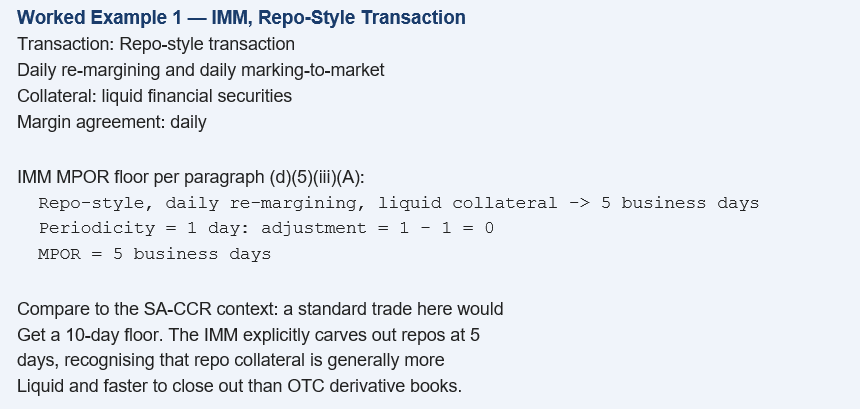
| Repo-style transactions with daily re-margining and daily marking-to-market, AND transactions with liquid financial collateral under a daily margin maintenance requirement | 5 business days for repos; 10 business days for other transactions | §217.132(d)(5)(iii)(A) |
| Netting set with >5,000 trades at any time in the prior quarter, or contains illiquid collateral or a derivative contract that cannot be easily replaced | 20 business days | §217.132(d)(5)(iii)(B) |
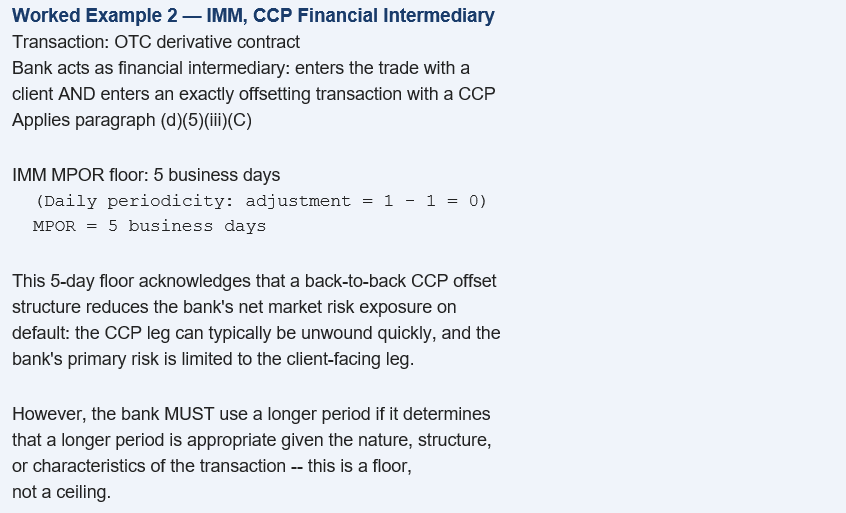
| OTC derivative contract where the bank acts as financial intermediary entering an offsetting CCP transaction, or where the bank provides a guarantee to the CCP on client performance | 5 business days | §217.132(d)(5)(iii)(C) |
The periodicity adjustment also applies under the IMM: if collateral is exchanged every N days, the minimum MPOR is the floor above plus N minus 1. And the same dispute-history doubling provision applies: if more than two margin disputes lasted longer than the MPOR in the previous two quarters, the minimum floor doubles.
The Key Difference Between SA-CCR and IMM MPOR Floors
| Dimension | SA-CCR (§217.132(c)(9)(iv)) | IMM (§217.132(d)(5)(iii)) |
| Standard floor (non-client/non-repo) | 10 business days | 10 business days (for standard transactions with liquid collateral and daily margin) |
| Client-facing or repo-style | 5 business days (client); N/A for repos | 5 business days for repos (daily re-margining + daily mark); 5 days also for CCP intermediary/guarantor |
| Large/illiquid netting sets | 20 business days | 20 business days |
| CCP financial intermediary / guarantor | Not separately named | 5 business days (explicit separate provision) |
| Dispute history | Floor doubles if >2 disputes lasting >MPOR in prior 2 quarters | Same rule applies |
| Periodicity adjustment | Plus periodicity in business days minus 1 | Plus N minus 1 (same formula) |
The floors are largely harmonised between the two frameworks — reflecting that the same real-world risk (time to close out and re-hedge) is being captured in both. The principal practical difference is the explicit 5-day CCP intermediary/guarantor floor in the IMM, which has no direct equivalent in the SA-CCR section, and the repo-style transaction treatment, which is explicitly carved out in the IMM at 5 days.
Worked Examples — IMM MPOR
Why MPOR Matters So Much in Practice
MPOR is not just a regulatory technicality. It is one of the most consequential inputs into a bank’s derivative capital calculation, for three reasons.
1. It Multiplies Into Every ADCA
In SA-CCR, the Maturity Factor — which is driven by MPOR — multiplies directly into every Adjusted Derivative Contract Amount across all five asset classes covered in our series. A 10-day MPOR produces MF = 0.3000; a 20-day MPOR produces MF = 0.4243. That is a 41% higher capital charge on the same underlying trade, caused solely by a longer MPOR. When scaled across a large derivatives book with thousands of trades, this difference is material.
2. It Creates Capital Incentives for Better Margin Practices
The regulatory MPOR floor structure is deliberately designed to reward operationally efficient margin processes and penalise poor ones. Daily margining beats weekly margining. A clean dispute history beats a contentious one. Liquid collateral beats illiquid collateral. Each of these factors directly affects the MPOR floor, and hence the capital cost. Banks that invest in strong margin operations — automation, legal documentation, dispute resolution — carry genuinely lower capital charges than those that do not.
3. It Connects Operational Risk to Market Risk Capital
The dispute-history doubling provision is a direct connection between operational failures in the margin process and increased market risk capital. A bank that repeatedly fails to resolve margin calls within the expected window is signalling that its close-out and re-hedging timeline is longer than the regulatory model assumes. The regulation responds by increasing the assumed MPOR — effectively making the bank hold more capital to reflect its own demonstrated operational limitations.
Quick Summary
- MPOR (Margin Period of Risk) is the period from the last collateral exchange until the bank has fully closed out the contracts and re-hedged all resulting market risk after a counterparty default.
- It captures three phases: (1) the gap from last exchange to the next required exchange, (2) the time to sell and realize the least liquid collateral, and (3) where applicable, the time to re-hedge market risk.
- In SA-CCR (§217.132(c)(9)(iv)), MPOR feeds into the Maturity Factor: MF = (3/2) × √(MPOR/250). Higher MPOR → higher MF → higher capital charge on every trade in the netting set.
- SA-CCR MPOR floors: 10 business days standard (non-client-facing), 5 business days client-facing, 20 business days for netting sets with >5,000 non-cleared trades, illiquid collateral, or hard-to-replace contracts. Dispute history doubles these floors.
- Re-margining periodicity adds to every floor: a weekly-margined trade (5 business days) adds 4 extra days to the standard floor, producing a 14-day MPOR where a daily-margined equivalent would produce 10 days.
- In the IMM (§217.132(d)(5)), MPOR governs how collateral agreements are captured inside a bank’s EAD model. The IMM definition is more granular and includes an explicit 5-business-day floor for repo-style transactions and CCP intermediary/guarantor positions.
- The SA-CCR and IMM floors are largely harmonised, with the key differences being the explicit repo/CCP intermediary floors in the IMM and the client-facing floor in SA-CCR.
Frequently Asked Questions
What exactly triggers the 20-business-day MPOR floor?
Three conditions individually trigger the 20-day floor under SA-CCR (§217.132(c)(9)(iv)(A)(2)(iii)): the netting set contains more than 5,000 derivative contracts that are not cleared transactions at any point; the netting set contains one or more trades involving illiquid collateral; or the netting set contains a derivative contract that cannot be easily replaced. Any single one of these conditions is enough to invoke the 20-day minimum, regardless of margining frequency.
Does a daily-settled (STM) trade get a 1-day MPOR?
No. As covered in §217.132(c)(9)(iv)(C), where a bank has elected to treat a settled-to-market cleared transaction as margined, the margined Maturity Factor formula applies with the standard MPOR floors — and daily settlement does not change the end date of the contract. The trade is not treated as a 1-day instrument simply because cash settles daily. The regulatory MPOR floors still apply in full.
How does the periodicity adjustment affect MPOR for bi-weekly margining?
If collateral is exchanged every 10 business days (bi-weekly), the periodicity adjustment is 10 − 1 = 9 days. For a standard non-client-facing trade, the MPOR floor becomes 10 + 9 = 19 business days. For a client-facing trade, it becomes 5 + 9 = 14 business days. Bi-weekly margining brings these floors close to — or in some cases exceeding — the large-netting-set 20-day threshold.
Why is the client-facing MPOR floor lower than the standard floor?
Client-facing derivative transactions — where the bank is dealing directly with a clearing member client in a centrally cleared structure — are typically simpler to close out and replace than bilateral OTC positions. The CCP structure provides standardisation, and the bank’s offsetting position with the CCP can generally be unwound quickly. The 5-day floor (versus 10 days) reflects this operationally faster close-out process.
What is the difference between MPOR under SA-CCR and under IMM?
The conceptual definition is the same — the time from last collateral exchange to fully closed-out and re-hedged position. The differences are in application: SA-CCR uses MPOR as a direct input to the Maturity Factor formula for every individual trade’s ADCA. IMM uses MPOR to set the time horizon over which a bank’s internal EAD model must capture the exposure, and provides more nuanced floors (explicit repo/CCP carve-outs) that the SA-CCR section does not name separately.
Read more articles on SA-CCR, Market Risk and Operational Risk in
https://decode-finance.com/category/market-risk-credit-risk-and-operational-risks/